
Ya Devi Sarvabhuteshu: The Story Behind the Prayer
Durga Saptashati (Devi Mahatmya), Adhyaya 5, Markandeya Purana · A FreeHindu reading for Durga Ashtami
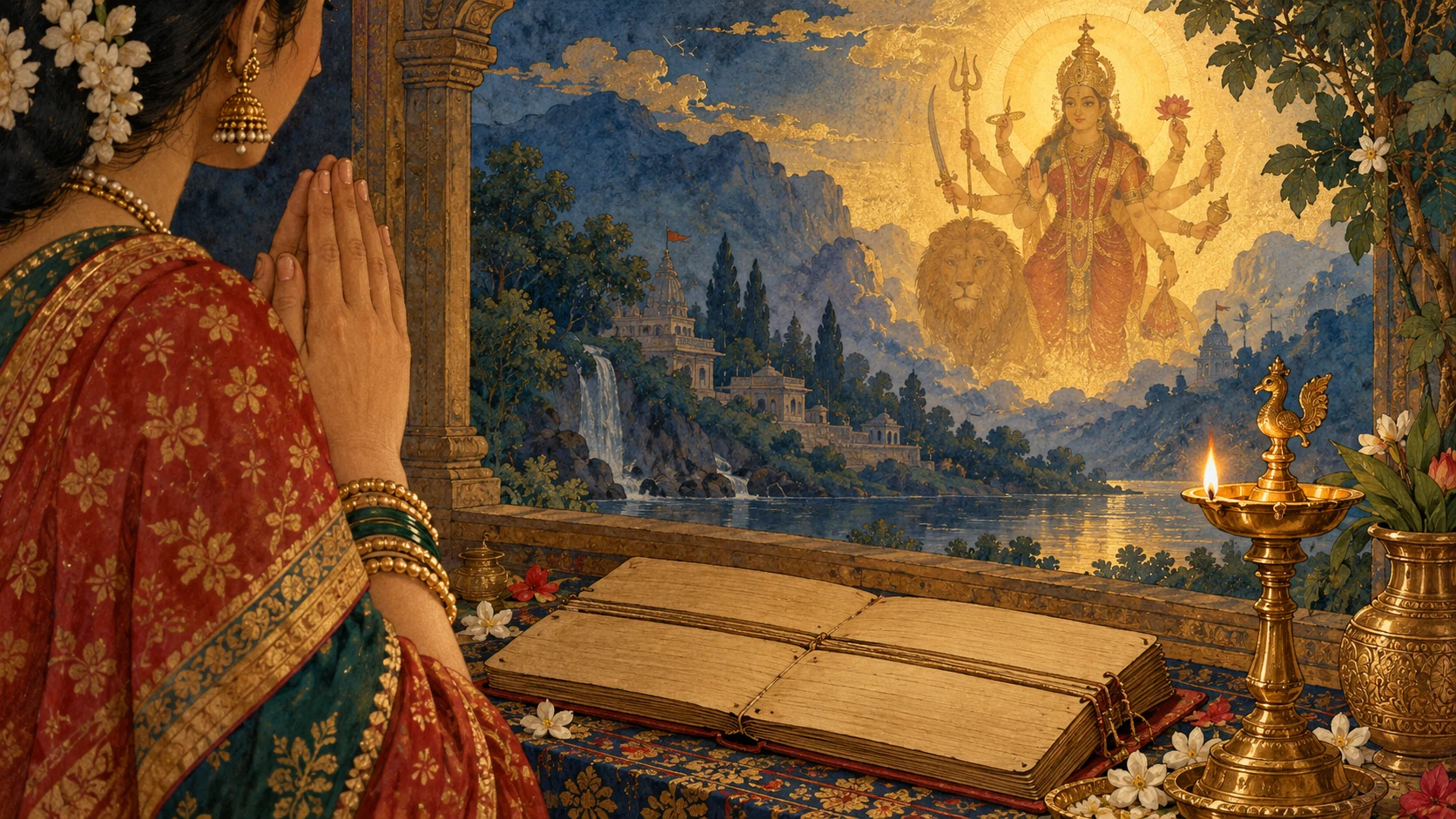
Some lines arrive in our lives before we are old enough to ask where they come from. They come through a grandmother's evening prayer, through the loudspeaker of a pandal down the road, through a song playing on a phone during Navaratri. या देवी सर्वभूतेषु शक्तिरूपेण संस्थिता is one of those lines. Many people who could not tell you a single other Sanskrit shloka can sing this one, with its rising first line and its gentle, repeated namastasyai that seems to settle into the breath.
Because it is so familiar, it is easy to hear it as a stand-alone prayer. But it has a home. It belongs to a particular moment in a particular story, and it was first sung by particular voices for a particular reason. The words mean more, not less, when we know who was speaking, what they had lost, and what happens as their praise unfolds.
In this Navaratri season, let us do what we try to do with every text: read it closely, keep the source in view, and think freely about what we find.
The shloka
या देवी सर्वभूतेषु शक्तिरूपेण संस्थिता ।
नमस्तस्यै नमस्तस्यै नमस्तस्यै नमो नमः ॥
yā devī sarvabhūteṣu śaktirūpeṇa saṃsthitā |
namas tasyai namas tasyai namas tasyai namo namaḥ ||
In simple words: To the Devi who lives in all beings as power (shakti): I bow to her, I bow to her, I bow to her, again and again.
सरल अर्थ: जो देवी सभी प्राणियों में शक्ति के रूप में रहती हैं, उन्हें नमस्कार, उन्हें नमस्कार, उन्हें नमस्कार, उन्हें बार-बार नमस्कार।
Source: Durga Saptashati (Devi Mahatmya), 5.32–34 in the traditional mantra numbering, within the Markandeya Purana. English and Hindi renderings are prepared for FreeHindu.
A story inside a story
The Durga Saptashati does not begin with the Devi. It begins with two ordinary, unhappy men.
The first is a king named Suratha, of the Chaitra line. The text tells us he cared for his people as if they were his own children. Then rival kings attacked him and, though they were weaker, they beat him in battle. He went back to his own city, only to find that his ministers, powerful and dishonest, had taken his treasury and his army. A king without a kingdom, he rode out alone on horseback, telling everyone he was going hunting, and entered a thick forest.
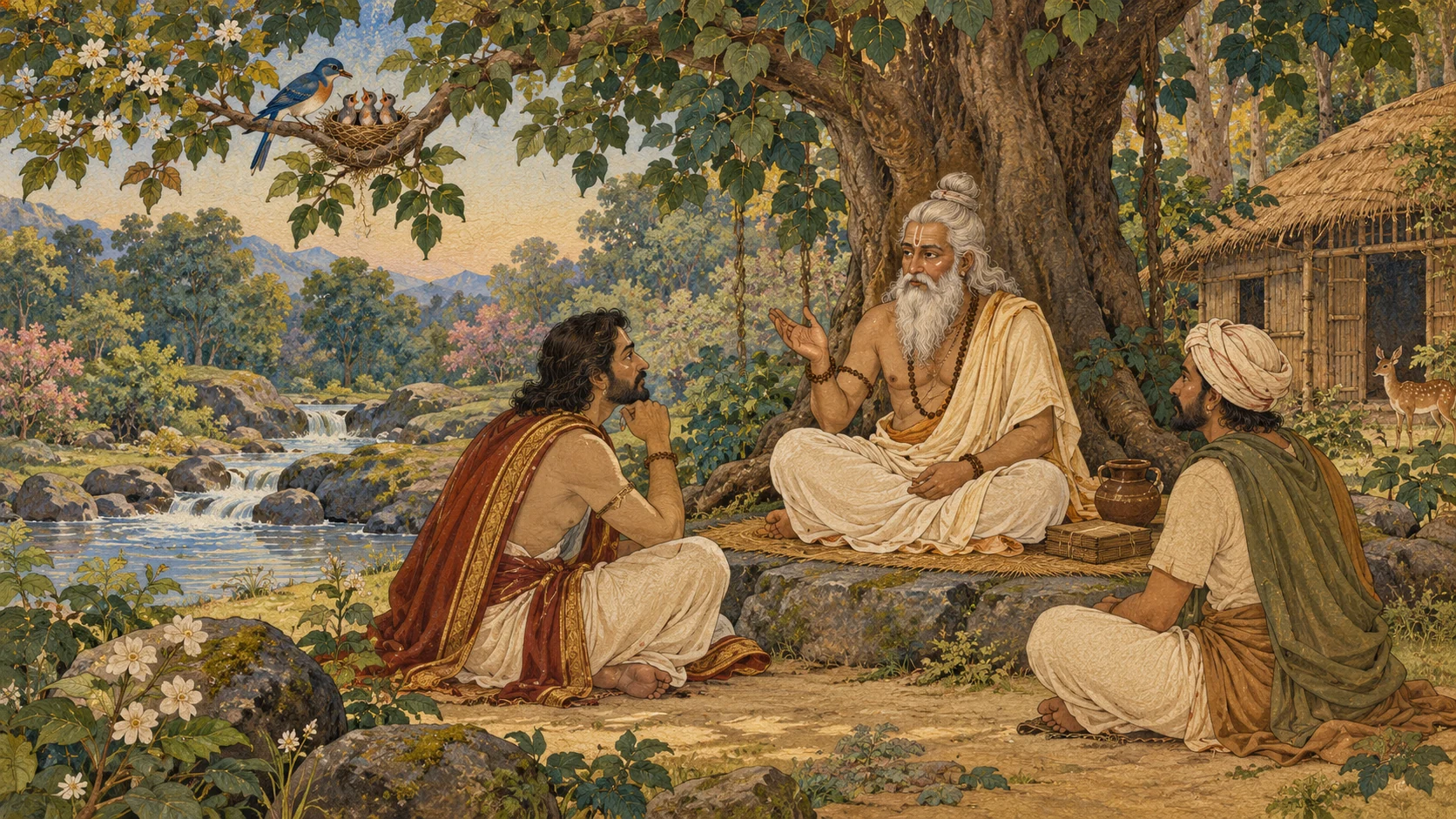
There he found the ashram of a rishi named Medha. It was a calm place. Even the wild animals there were peaceful, and the rishi's students moved about it quietly. Medha welcomed the king, and Suratha stayed for a while. But his mind would not rest. He kept thinking about the city his ancestors had ruled and that was no longer his. Were his servants ruling it fairly? What was happening to his great war elephant, now in enemy hands? The people who had once lived on his kindness and his money were surely serving other kings now, and the treasury he had filled with so much effort would be emptied by people who spent carelessly.
Near the ashram he met a second man who looked just as troubled. This was Samadhi, a merchant born into a wealthy family. His own wife and sons, greedy for his money, had thrown him out and kept his wealth. He had come to the forest grieving, abandoned even by close relatives. And yet, he told the king, he could not stop worrying about them. Were his sons well? Were they living good lives or bad ones? Was there peace at home?
Suratha asked the obvious question: why do you still care for people who threw you out? The merchant's answer is one of the most human moments in the text. He says, in effect: I know. I can see it. And still my mind will not turn hard against them. I don't understand it myself.
So the two men went to the rishi together, and the king put the question for both of them. We both know these things are causing us pain. We both see the faults in the people and things we long for. Why, then, are our minds still pulled towards them? Why is there this confusion even in people who know better?
Medha's answer is gentle and surprising. Knowledge, he says, is not rare; every creature has it. Look at the birds. Even when they are tormented by hunger themselves, they drop grain into the beaks of their young, held by attachment. People too long for their children, hoping to be cared for in return. This pull, Medha says, comes from Mahamaya, the great power of Vishnu that keeps the world turning. She draws the minds of even the wise into confusion. And when she is pleased, the same Devi becomes the cause of freedom.
Naturally the king asks: who is this Devi you call Mahamaya? How did she come to be? What has she done? And so Medha begins to tell her stories. Everything that follows in the Durga Saptashati, including our shloka, is his answer to two heartbroken men in a forest.
There is one more layer. The whole conversation is itself being retold by the rishi Markandeya, who opens the text by announcing that he will explain how Savarni came to be the eighth Manu. Only at the very end do we learn why: after hearing Medha out, Suratha and Samadhi go to a riverbank, make an image of the Devi from clay and worship her for three years. She appears to them. The king asks for his kingdom back and is told he will regain it, and that in a later birth he will become Savarni, the Manu. The merchant, tired of the world, asks for something else: the knowledge that loosens the grip of "I" and "mine". She grants it.
So when the devas sing "Ya devi sarvabhuteshu" on the mountain, we are hearing a story told by Medha, within a story told by Markandeya, preserved in the Markandeya Purana. The hymn is not only the devas' prayer. It is also part of a teacher's answer to the question why can't I let go?
Seven hundred mantras, three journeys
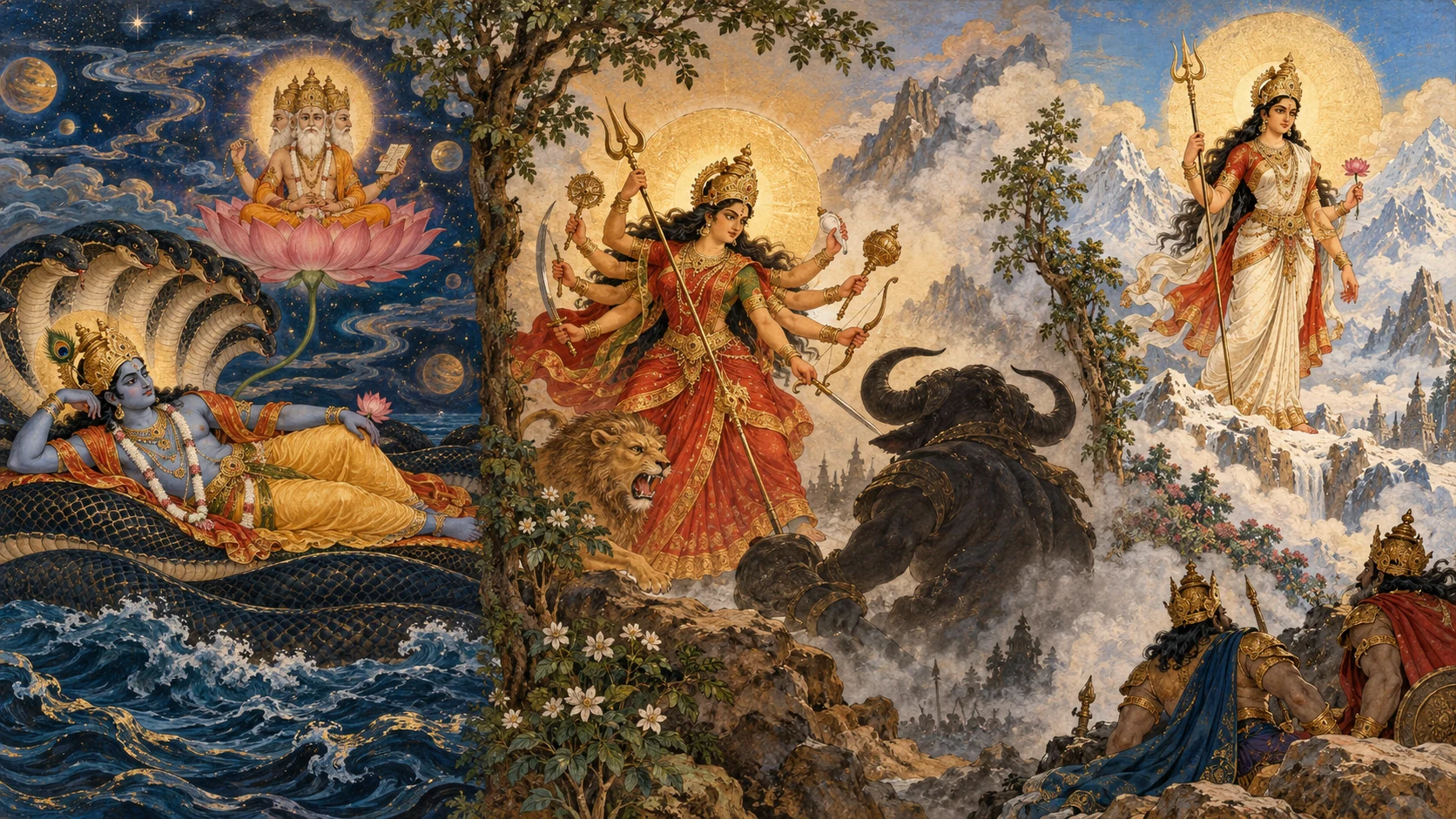
The Devi Mahatmya is better known in many homes as the Durga Saptashati, "the seven hundred" (saptashati), for the traditional count of its mantras. It is also simply called the Chandi, or Chandi Path when recited. It forms a section of the Markandeya Purana and is arranged in 13 adhyayas, grouped into three charitras, or "accounts":
- Prathama Charitra (Adhyaya 1), whose presiding Devi is Mahakali. Here the Devi, as the sleep of Vishnu, withdraws from him so that he can wake and fight the asuras Madhu and Kaitabha.
- Madhyama Charitra (Adhyayas 2 to 4), whose presiding Devi is Mahalakshmi. This is the story of Mahishasura and the radiant Devi born from the combined energy of the devas.
- Uttama Charitra (Adhyayas 5 to 13), whose presiding Devi is Mahasaraswati. This is the story of Shumbha and Nishumbha and the Devi's battles with their generals, followed by the devas' great hymn of thanks, the Devi's promises, and the end of the frame story.
Adhyaya 5 is therefore a doorway. It opens the third and longest of the three accounts. In the traditional mantra numbering, it is also the longest single adhyaya, and its traditional title is Devya Duta Samvada, "the Devi's conversation with the messenger". That title already hints at something we will come back to: the famous hymn is only the first half of the adhyaya. The second half is a tense exchange between the Devi and an asura envoy.
When was all this composed? Tradition treats the text as ancient and revealed. Historians generally place its composition somewhere in the middle of the first millennium CE, often around the fifth or sixth century, while noting that its traditions have earlier roots. This is a historical estimate of the text’s composition, distinct from its sacred status in tradition; the text itself supplies no composition date.
When the three worlds changed hands
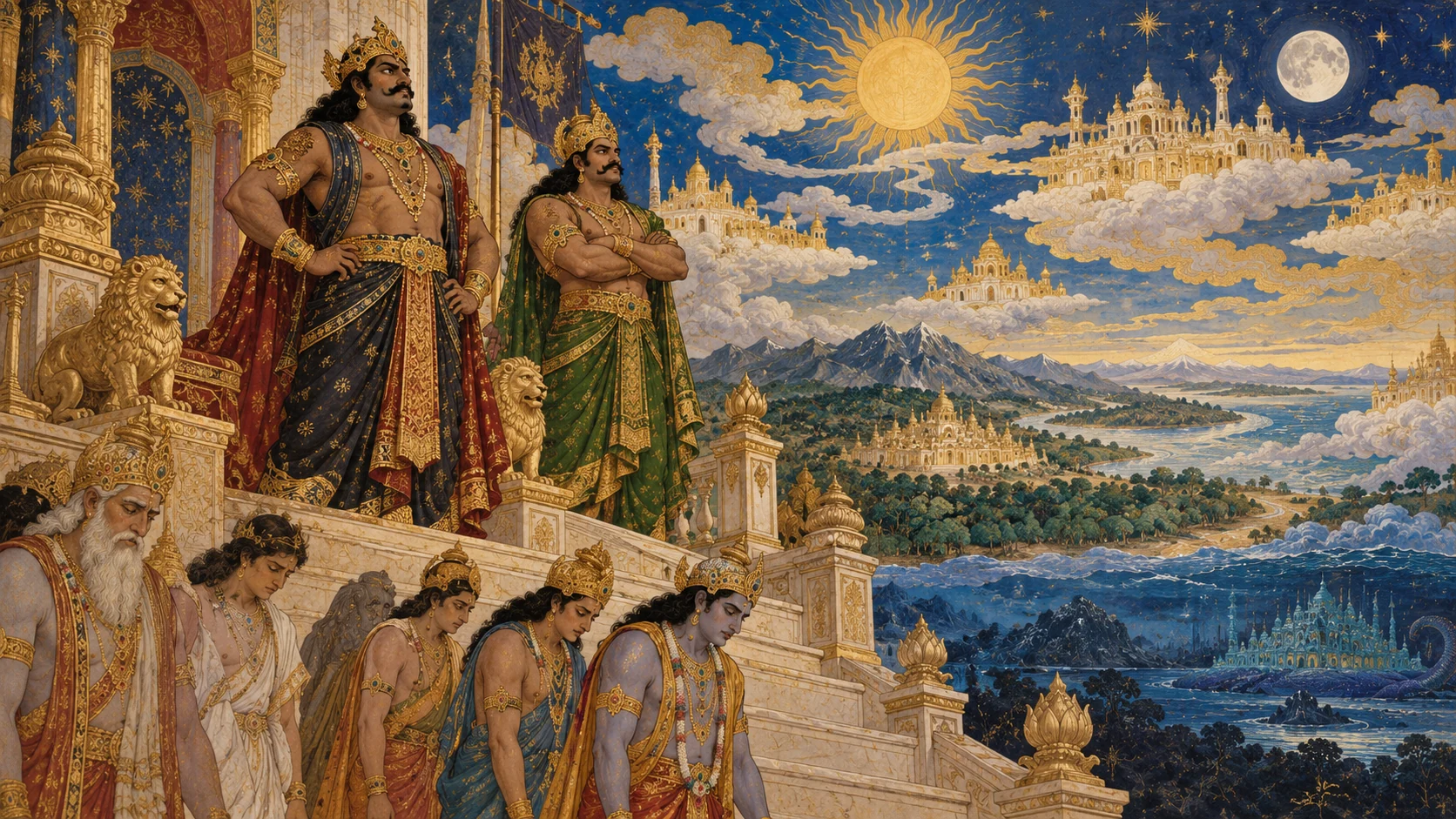
At the close of Adhyaya 4, after the defeat of Mahishasura, Medha had already given the king a preview. The Devi, he said, once arose from the bodies of the devas; now hear how she arose again, from the body of Gauri, to destroy the asuras Shumbha and Nishumbha and protect the worlds.
Adhyaya 5 opens with Medha speaking again. Long ago, he says, two asura brothers, Shumbha and Nishumbha, proud of their strength, took the three worlds away from Indra, the husband of Shachi. They took the share of the yajna that belonged to the devas. And they did not stop there. They took over the work of Surya, the sun, and the office of Chandra, the moon. They took what belonged to Kubera, to Yama and to Varuna. They took the power of Vayu, the wind, and did the work of Agni, the fire.
The asuras do not just win a battle. They take over the work that keeps the world running: light, night, wealth, death, the waters, the wind, the fire. The devas are driven out, stripped of their kingdoms and their offices.
A promise remembered
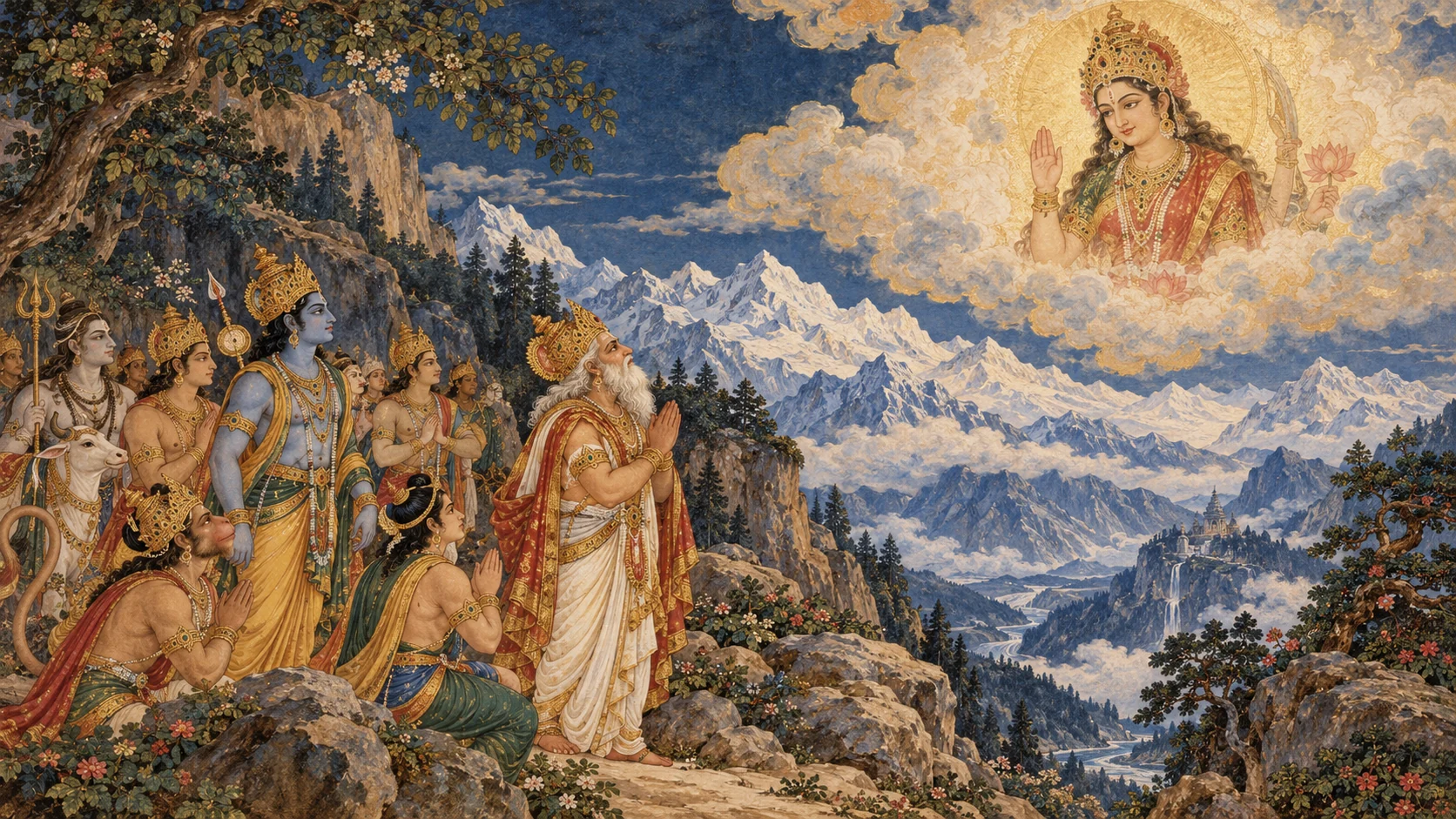
What do the devas do? They remember.
At the end of Adhyaya 4, after the Devi had freed them from Mahishasura, she had offered them a boon. Their answer was simple: whenever we remember you, again and again, please destroy our worst troubles. She said, "So be it," and disappeared.
Now, thrown out of their own worlds, the devas recall that moment. In Adhyaya 5 they put her promise in her own words: "Whenever you remember me in trouble, I will end your worst troubles at once." The text says they remembered the Devi who is aparajita, "never defeated". It is a quiet and moving detail. The devas themselves have been defeated, so they turn to the one who has never been.
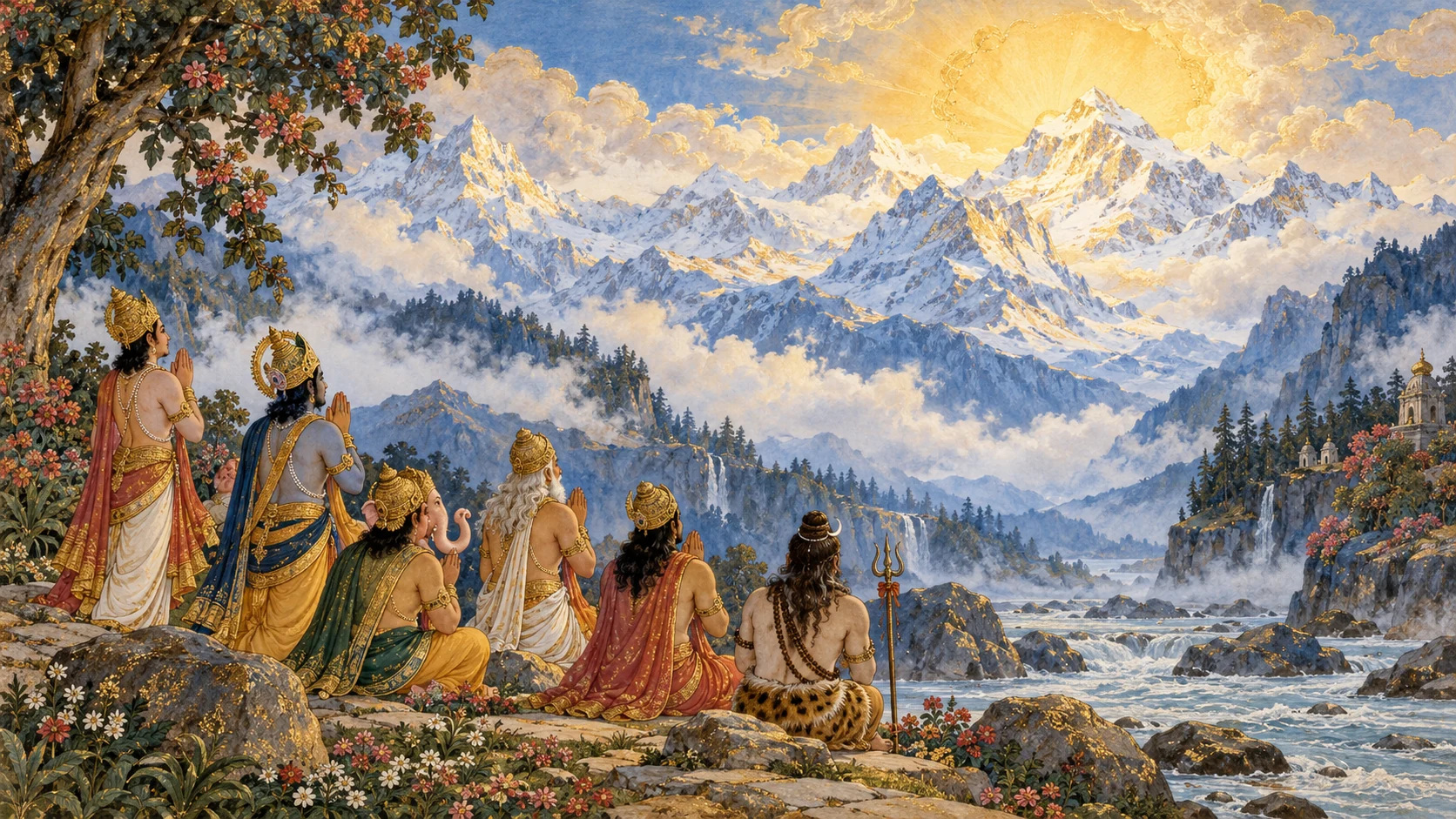
With that thought in mind, they go to Himavan, the king of mountains, and there they begin to praise the Devi, whom the text here calls Vishnumaya.
A hymn on the mountain
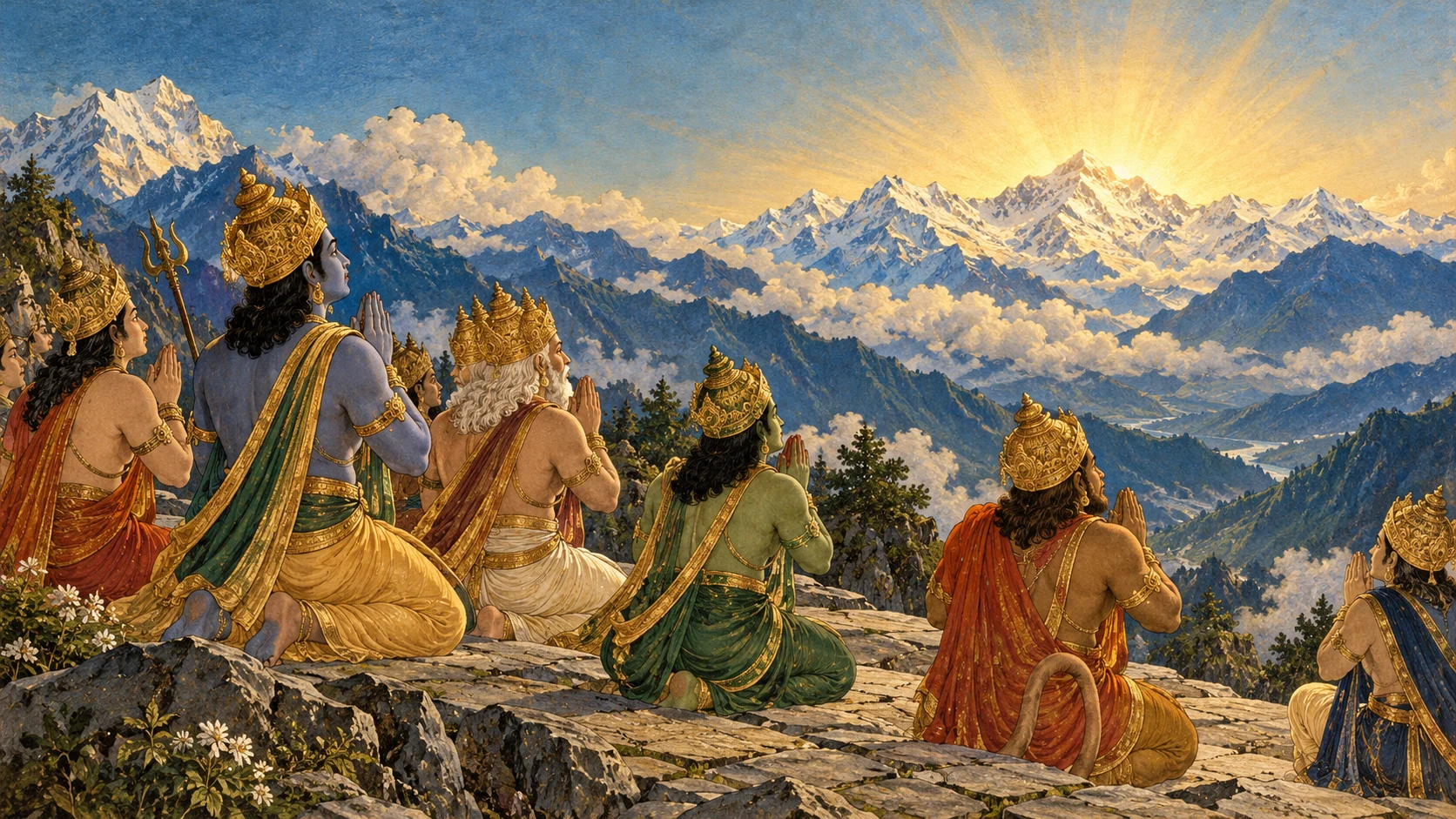
Because of that word aparajita, the devas' hymn is widely known as the Aparajita Stuti. The name comes from tradition rather than from a title in the text, but it fits.
The hymn begins with a stream of salutations. The devas bow to the Devi as Mahadevi and as Shivā, the auspicious one. They bow to her as Prakriti, nature itself, and as Bhadra, the kind one. They bow to her as Raudra, the fierce one, and as Nitya, the eternal one; as Gauri and as Dhatri, the one who supports; as moonlight and as happiness itself. They call her Durga, the one who carries us across hard places; they call her Krishna, the dark one, and Dhumra, the smoke-coloured one. And then comes a phrase that says a great deal in very little: they bow to the one who is at once very gentle and very fierce (atisaumya and atiraudra).
Then the hymn changes rhythm. A single line begins to repeat, each time with one word changed, and that line is the one we know.
The line, word by word
| Sanskrit | IAST | Simple meaning |
|---|---|---|
| या | yā | who, the one who |
| देवी | devī | the Devi, the Goddess |
| सर्वभूतेषु | sarvabhūteṣu | in all beings (sarva = all, bhūta = being) |
| शक्तिरूपेण | śaktirūpeṇa | as shakti, in the form of power (rūpa = form) |
| संस्थिता | saṃsthitā | is present, firmly dwells |
| नमः | namaḥ | I bow, salutation |
| तस्यै | tasyai | to her |
| नमस्तस्यै | namas tasyai | I bow to her (namaḥ + tasyai) |
| नमो नमः | namo namaḥ | I bow again and again |
A few small things are worth noticing.
Sarvabhūteṣu means "in all beings". The word bhūta covers everything that has come into being, not only humans. The line does not say the Devi lives in good people, or in devotees, or in the devas who are singing. It says all beings, and it means all.
Saṃsthitā is stronger than "visits" or "appears". It suggests being settled, standing firmly in place. The Devi is not passing through. She dwells.
Namastasyai is said three times, and then the line closes with namo namaḥ. In the Sanskrit, the repetition is part of the text itself; it is not a later habit added by singers. One way to hear it, and this is our reading rather than anything the text explains, is that a single "I bow" is not enough for something that is everywhere. The words keep bowing because there is always more to bow to.
Twenty-one ways of being present
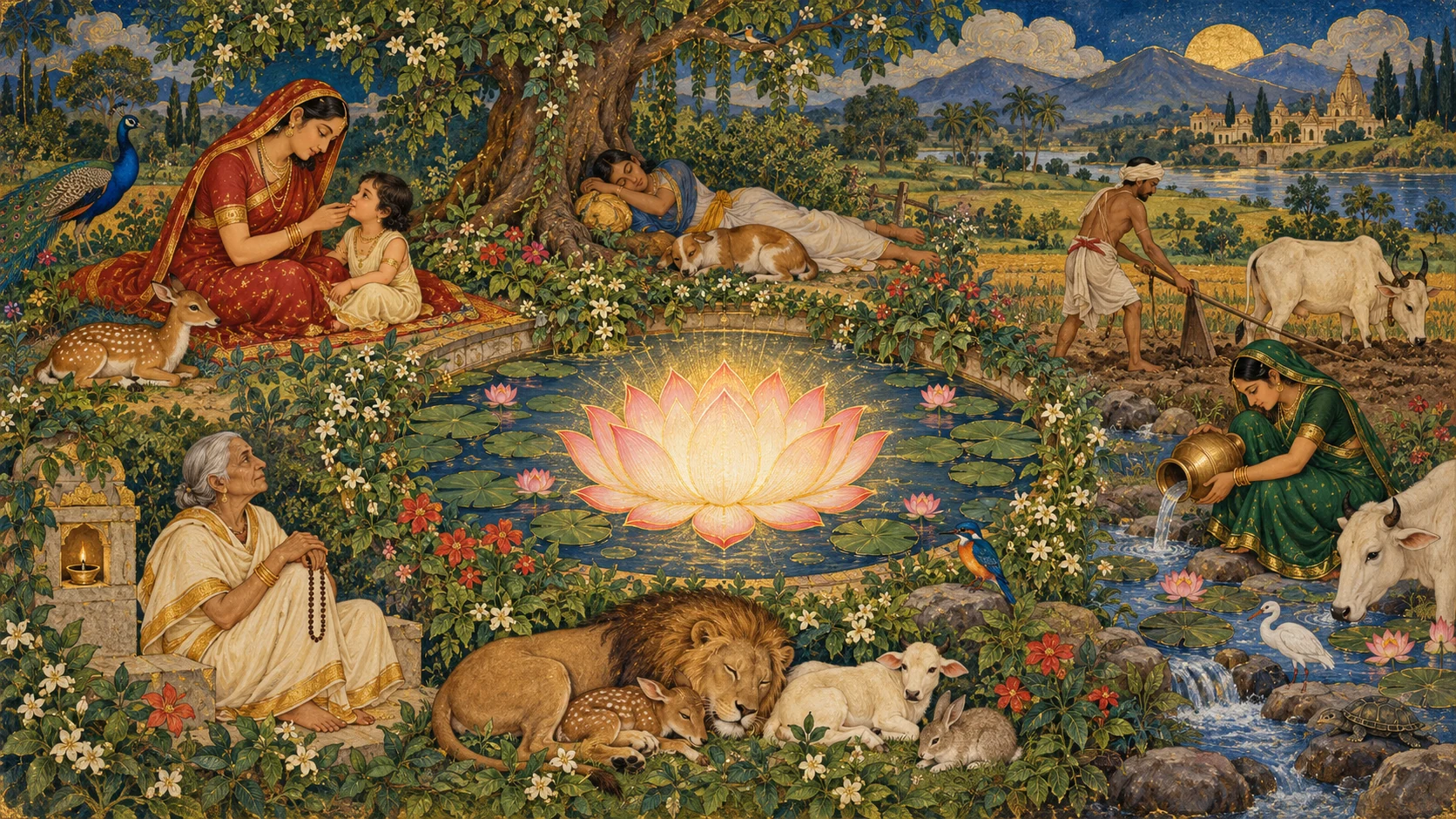
The famous line, with shakti, is just one of a series. The devas repeat the opening "ya devi sarvabhuteshu" twenty-one times, and each time they name a different form in which the Devi is present in all beings. Here they are, in the order the text gives them.
| # | Sanskrit | IAST | Simple meaning |
|---|---|---|---|
| 1 | विष्णुमाया | viṣṇumāyā | the maya (power) of Vishnu |
| 2 | चेतना | cetanā | awareness |
| 3 | बुद्धि | buddhi | intellect, understanding |
| 4 | निद्रा | nidrā | sleep |
| 5 | क्षुधा | kṣudhā | hunger |
| 6 | छाया | chāyā | shadow, shade |
| 7 | शक्ति | śakti | power, strength |
| 8 | तृष्णा | tṛṣṇā | thirst, craving |
| 9 | क्षान्ति | kṣānti | forgiveness, patience |
| 10 | जाति | jāti | birth, kind or species |
| 11 | लज्जा | lajjā | modesty, a sense of shame |
| 12 | शान्ति | śānti | peace |
| 13 | श्रद्धा | śraddhā | faith, trust |
| 14 | कान्ति | kānti | radiance, beauty |
| 15 | लक्ष्मी | lakṣmī | prosperity, good fortune |
| 16 | वृत्ति | vṛtti | livelihood, way of living |
| 17 | स्मृति | smṛti | memory |
| 18 | दया | dayā | compassion |
| 19 | तुष्टि | tuṣṭi | contentment |
| 20 | मातृ | mātṛ | mother, motherhood |
| 21 | भ्रान्ति | bhrānti | illusion, confusion |
There is a small change in wording that is easy to miss. For the first two forms, the text does not say "dwells in the form of". It says the Devi "is called" Vishnumaya in all beings, and "is known as" awareness in all beings. From the third form onwards, buddhi, the familiar phrase rūpeṇa saṃsthitā, "dwells in the form of", takes over and stays until the end. The well-known shakti line is the seventh in the series.
Source: Devi Mahatmya 5.14–76. These are the twenty-one occurrences of the “yā devī sarvabhūteṣu” opening; the subsequent praise of the senses and consciousness continues the hymn.
Sleep, hunger, shadow, thirst
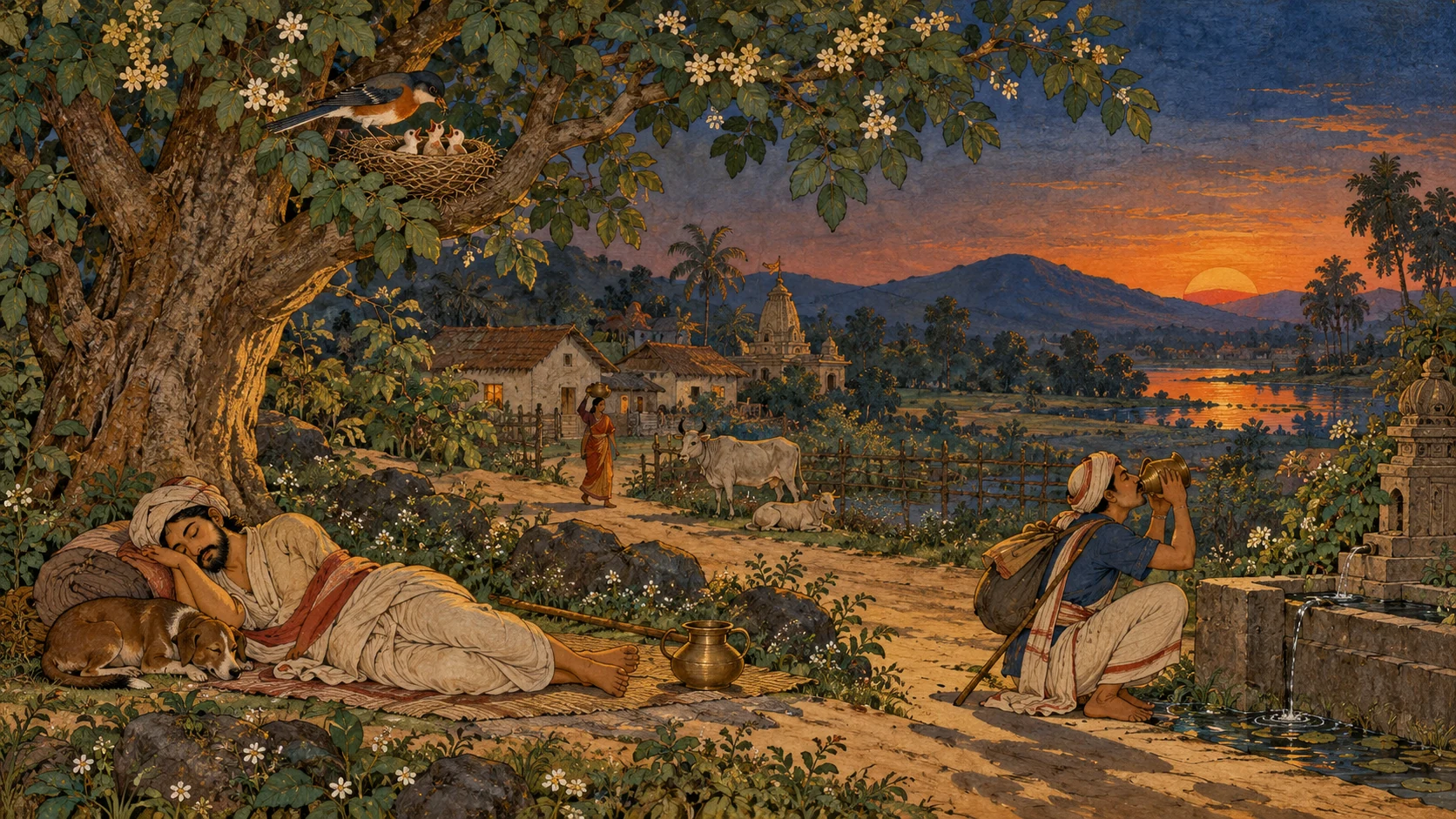
Read the list slowly and something unexpected happens. We might expect a hymn to a goddess to list only lovely things: peace, faith, compassion, beauty. Those are here. But so are sleep, hunger, shadow, thirst and, at the very end, illusion.
What follows is our reflection, offered as one reading among many; the text itself simply lists the forms and bows to each.
Sleep is where we stop being in control. Hunger and thirst are the most basic restlessness of any body. Shadow is what we usually think of as the absence of light. Illusion is the very thing that, in the frame story, made a king and a merchant miserable. And yet the devas bow to the Devi in each of these, with exactly the same words they use for peace and compassion. There is no second, lesser formula for the uncomfortable forms.
One way to understand this is that the hymn refuses to split the world into a sacred half and an ordinary half. Whatever moves a living being, whether it lifts us up or drags us down, is treated as her presence. The hungry bird in Medha's story feeds its young even while its own hunger remains. Sleep, in Adhyaya 1, is the Devi herself as yoganidra, resting in Vishnu's eyes. And illusion, bhranti, echoes Mahamaya, who the rishi said pulls even wise minds into confusion and, when pleased, sets them free. Seen this way, the list quietly answers Suratha's question. The power that binds you and the power that frees you are not two different powers.
It is also striking how ordinary many of the "good" forms are. Vritti is livelihood, the work by which a person lives. Lajja is the small, private sense of shame that stops us before we do something we would regret. Tushti is contentment, the feeling of "this is enough". These belong not only to saints but to farmers, traders, students and parents. The hymn finds the Devi in the texture of daily life.
And then there is matri, mother. Placed near the end, just before illusion, it is the form many listeners hold closest. Whatever else she is, the hymn suggests, she is also present in every being as the one who gives birth and care.
The opening praise, "very gentle and very fierce", already prepared us for this. The twenty-one forms spell it out across the whole range of life.
Ruler of the senses, pure consciousness
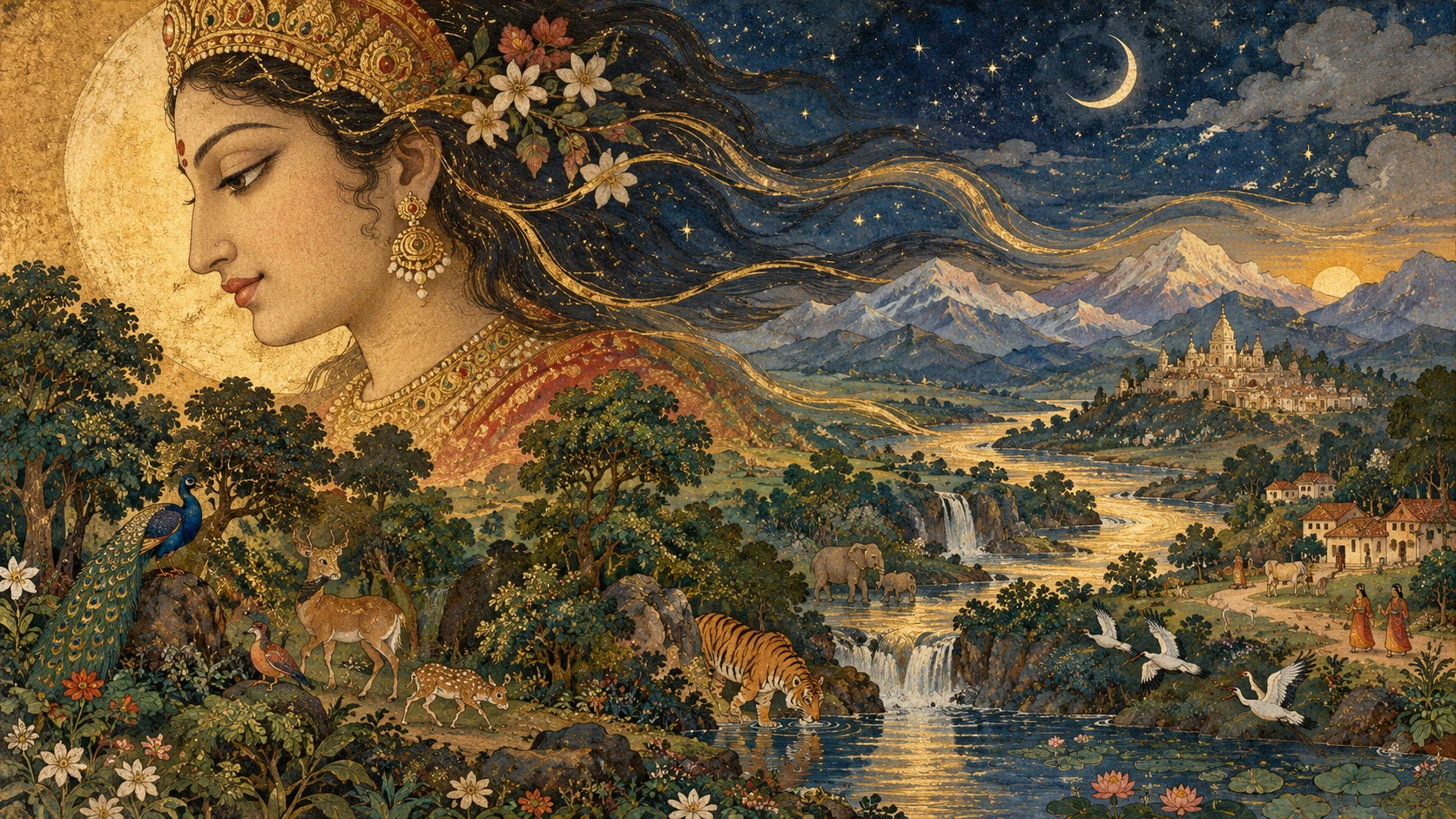
After the twenty-one forms, the hymn widens its view. The devas bow to the Devi as the one who rules over the senses of all beings and who is always present in every being, the Devi who pervades everything.
Then comes one last verse, in the same rhythm and with the same threefold namastasyai:
चितिरूपेण या कृत्स्नमेतद् व्याप्य स्थिता जगत् ।
नमस्तस्यै नमस्तस्यै नमस्तस्यै नमो नमः ॥
citirūpeṇa yā kṛtsnam etad vyāpya sthitā jagat |
namas tasyai namas tasyai namas tasyai namo namaḥ ||
In simple words: To her who, as consciousness (chiti), fills this whole world and stays in it: I bow to her, I bow to her, I bow to her, again and again.
The hymn now moves from "in all beings" to "this whole world". One way to read this widening is that the many forms are gathered into chiti, consciousness itself. Understanding this as the awareness through which the world is known is a philosophical reading of the verse, rather than a literal translation of every word.
The devas then close with two longer verses. They recall that they once praised her to get what they longed for, and that Indra honoured her in better days. May she, the ruler of all, bring us good and destroy our troubles. And they describe themselves as they are right now: tormented by arrogant asuras, bowing to her in devotion, and trusting that she, the moment she is remembered, ends all their troubles at once. The promise from Adhyaya 4 comes back as the last note of the hymn.
A Devi steps out of Parvati
Here the story takes a turn that is easy to forget when the hymn is sung on its own.
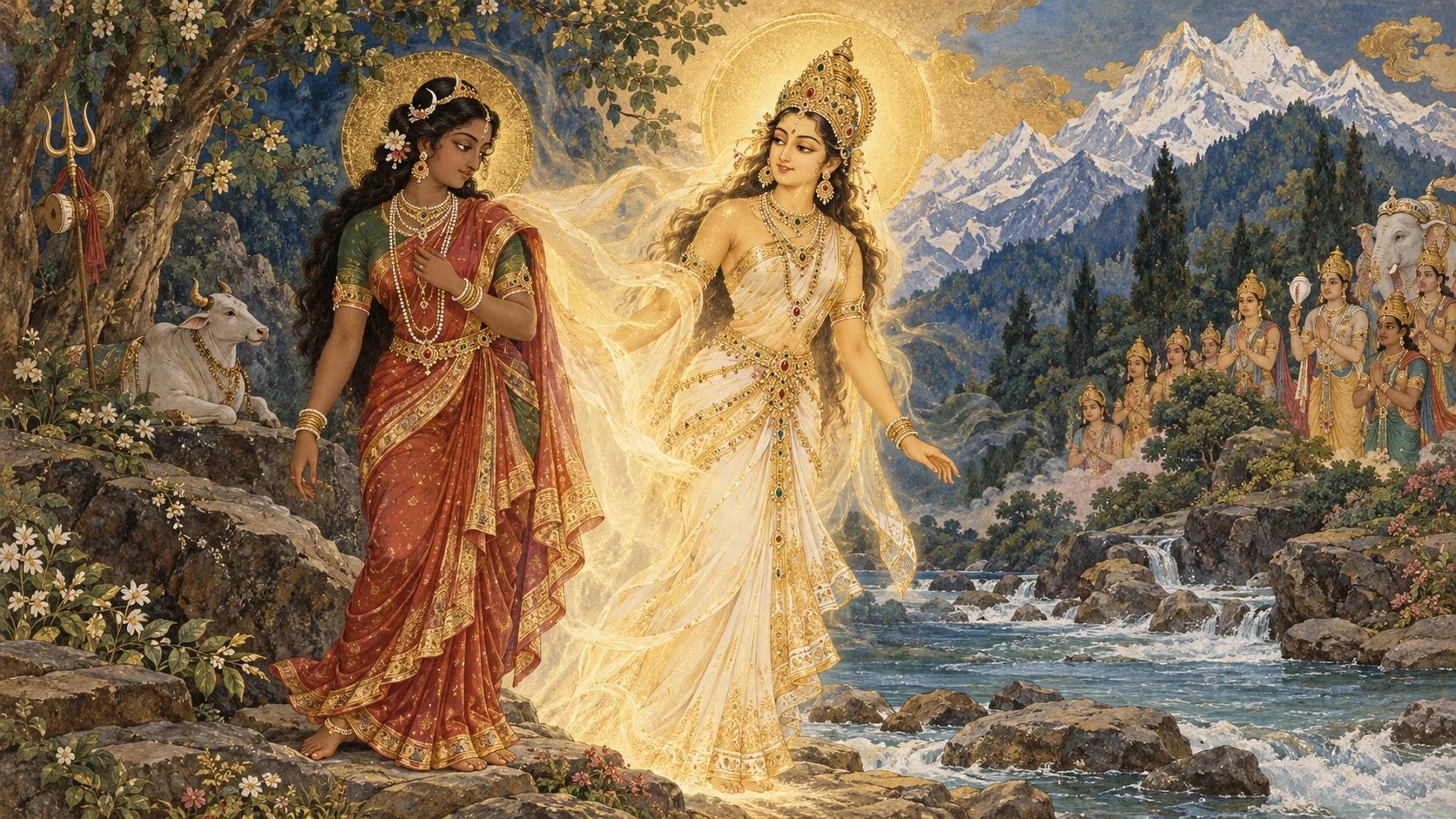
While the devas are still busy with their praise, Medha tells the king, Parvati comes to that place to bathe in the waters of the Ganga. Seeing them, she asks, "Whom are you praising here?"
Before the devas can answer, a Devi comes out of the sheath of Parvati's own body. She is Shivā, the auspicious one, and she answers for them: "This hymn is for me. The devas have gathered to sing it because Shumbha has thrown them out, and Nishumbha has defeated them in battle."
Because this Devi, Ambika, came out of the kosha, the body-sheath, of Parvati, she is sung of in all the worlds as Kaushiki. Once she has come out, Parvati herself turns dark. She becomes known as Kalika, and she makes the Himalaya her home.
There is a gentle irony here. Parvati asks whom the devas are praising, and the answer comes from within her own body. It is hard not to hear an echo of the hymn's own claim, that the Devi dwells in all beings.
Two dark goddesses, two moments
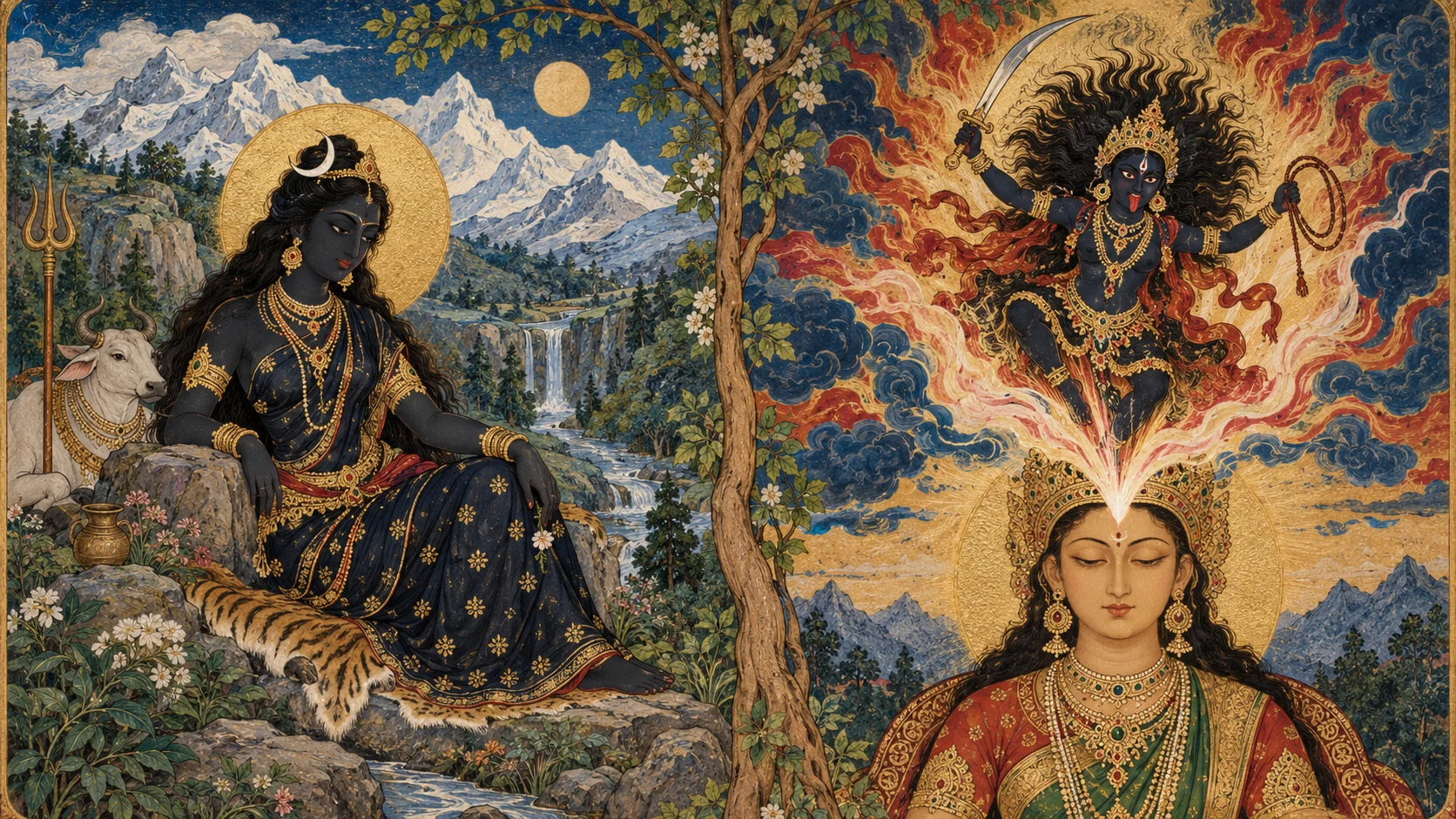
A word of care is needed here, because the Durga Saptashati has two dark goddesses whose names sound alike, and they are easily merged.
In Adhyaya 5, the one called Kalika is Parvati herself, who becomes dark once Kaushiki has come out of her body. The text says only that she became dark, was known as Kalika and made the Himalaya her home. She does not go into battle in this adhyaya.
In Adhyaya 7, a different figure appears. When Chanda and Munda come with an army to seize Ambika, Ambika's face turns dark as ink with anger, and from her frowning forehead springs Kali, fearsome, wide-mouthed, with a sword and a noose. It is this Kali who destroys Chanda and Munda, and who is then given the name Chamunda.
So one dark Devi is what Parvati becomes when Kaushiki leaves her; the other springs from Kaushiki's own anger in battle. Many traditions see all of them as forms of the one Devi, but as a matter of reading the story, it is clearer to keep the two moments apart.
A list of treasures, and one more
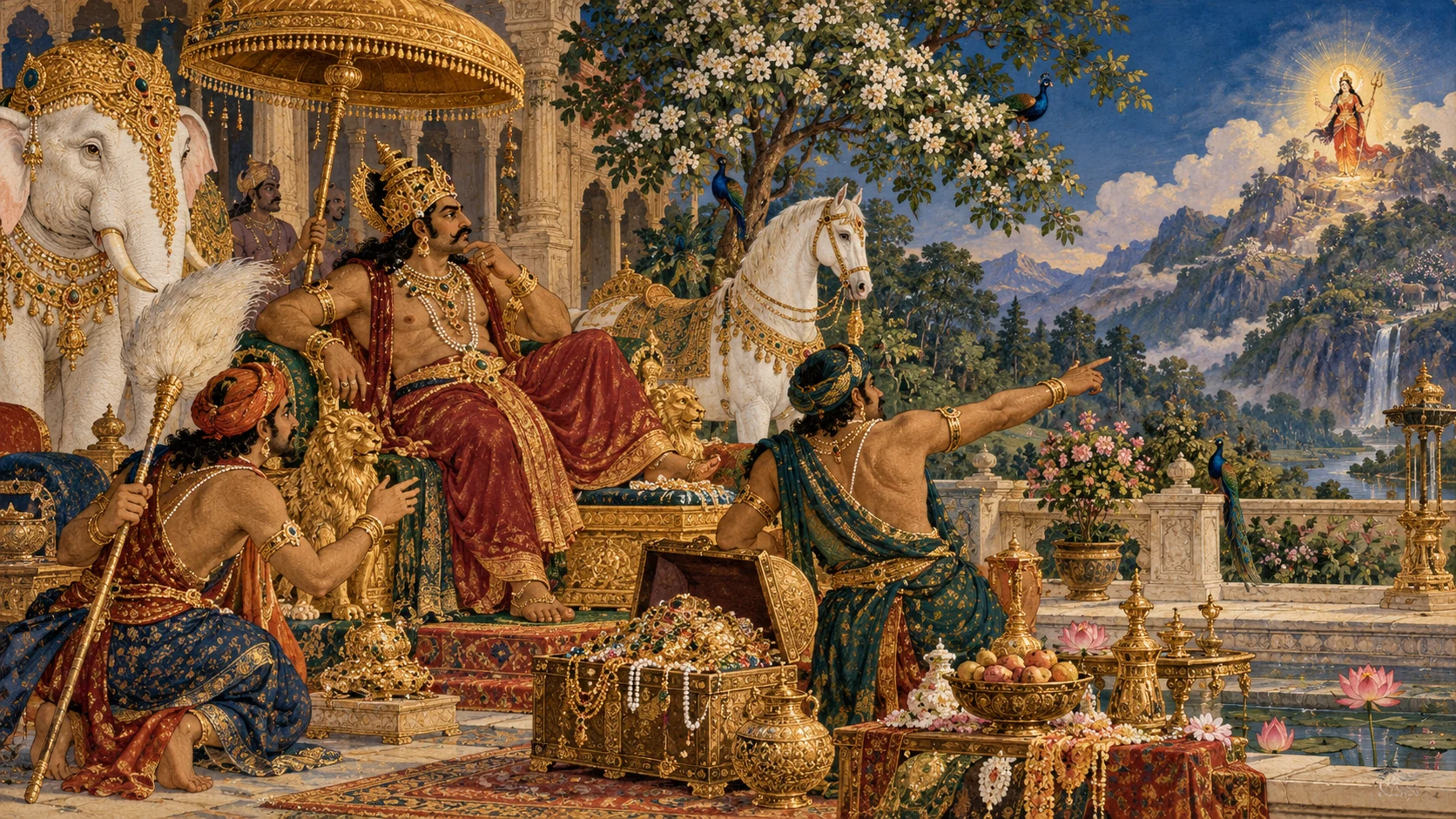
Now the asuras enter the scene. Chanda and Munda, two servants of Shumbha and Nishumbha, see Ambika on the mountain in her supremely beautiful form. They hurry to Shumbha with the news. "Great king," they say, "there is a woman on the Himalaya who lights up the whole mountain. No one has ever seen such beauty anywhere. Find out who she is, and take her."
To make their case, they remind him of everything he has already seized. And the list is long: Airavata, Indra's great elephant; the Parijata tree; the horse Uchchaihshravas; the swan-drawn vimana that once belonged to Brahma, now standing in Shumbha's courtyard; the great treasure Mahapadma, taken from Kubera; a garland of never-fading lotuses given by the ocean; Varuna's umbrella that showers gold; the finest chariot of Prajapati; even a power taken from Mrityu, death; Varuna's noose, now with Shumbha's brother; all the gems born of the ocean, now with Nishumbha; and two garments purified by fire, given by Agni himself. "You have every treasure of the three worlds," they say. "Why not take this jewel among women too?"
In the asuras' eyes, the Devi is simply the next item on a list of possessions, the very opposite of how the devas, moments earlier, saw her: as the power present in everything.
A messenger with a sweet voice
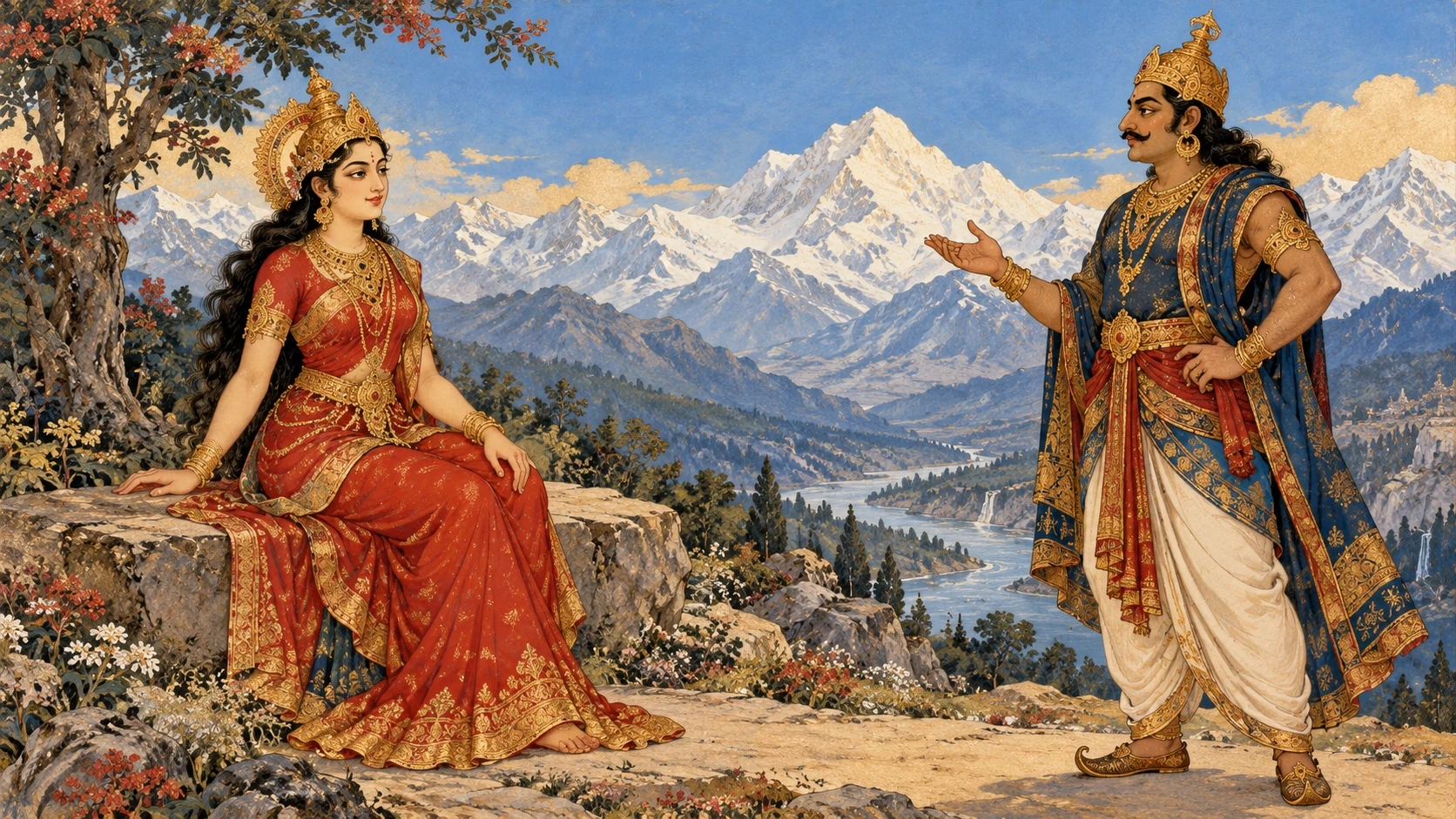
Shumbha likes the idea. He sends a great asura named Sugriva as his messenger. (This is not the Sugriva of the Ramayana, the vanara king and friend of Rama; it is simply the same name, which means "the one with a fine neck", carried by a very different character.) Shumbha's instructions are to say whatever is needed and to make sure she comes quickly, and willingly.
Sugriva goes to the lovely spot on the mountain where the Devi is staying and speaks to her smoothly, in a sweet voice. His message, delivered in Shumbha's own words, is a long boast. The three worlds are mine. The devas obey me. I enjoy every share of the yajna. Every fine treasure in the three worlds is under my control: Indra's elephant, the horse that rose from the churning of the milk ocean, which the devas themselves handed over with folded hands. Whatever is precious among the devas, gandharvas and nagas is now with me. We think of you as the jewel among women. Come to us, then, since we are the ones who enjoy jewels. Choose me, or my brother, the mighty Nishumbha. Marry me and you will have power and wealth beyond compare. Think it over.
The vow
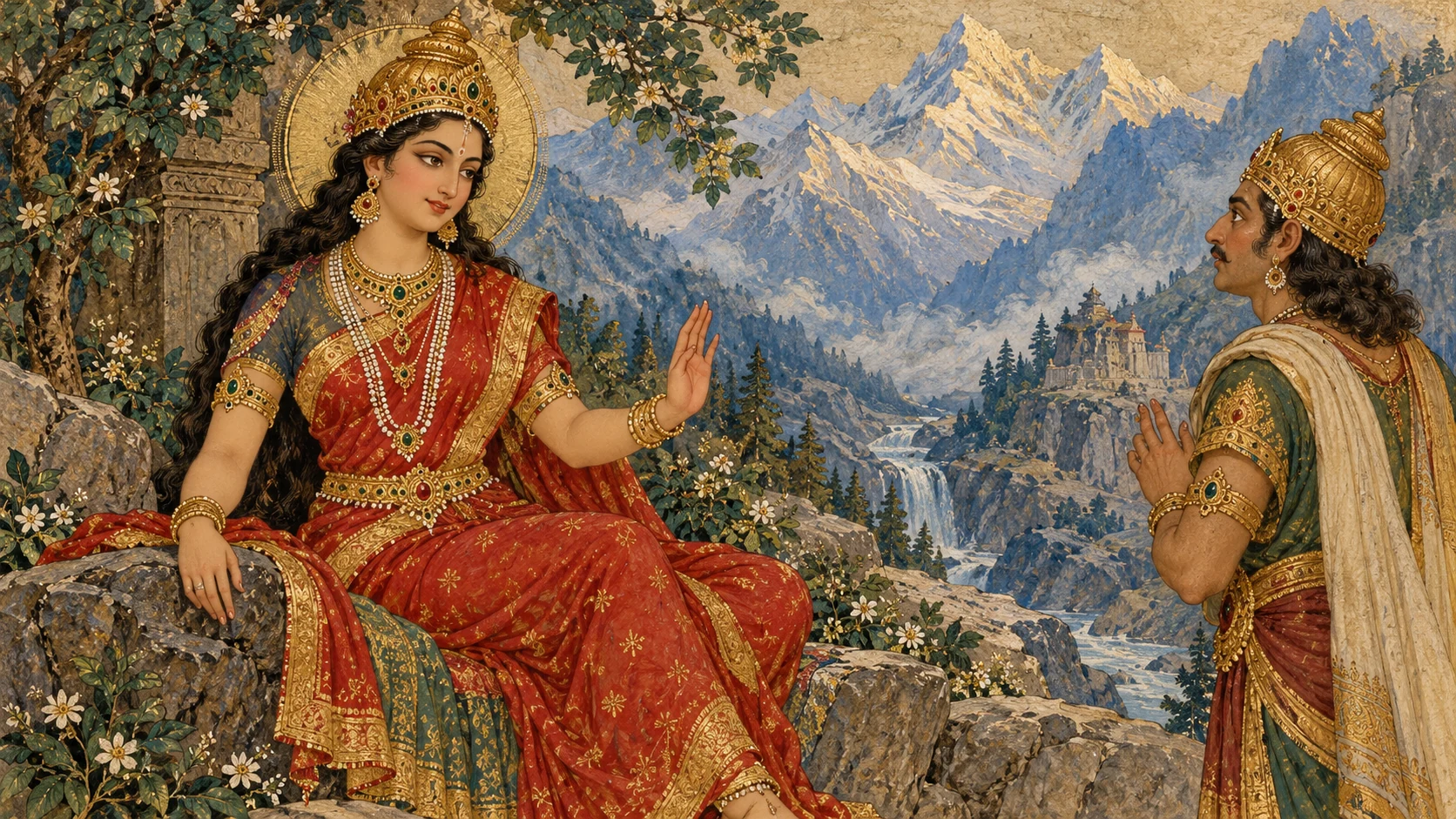
The Devi's reply is one of the finest moments in the text. Medha says that she smiled, deep inside. And he reminds the king exactly who is smiling: Durga, the Bhagavati, the kind one, by whom this whole world is held up.
She says: "What you have said is true. There is nothing false in it. Shumbha is the lord of the three worlds, and Nishumbha is just as great. But how can I break a promise I have made? Listen to the vow I made long ago, out of my small understanding:
यो मां जयति सङ्ग्रामे यो मे दर्पं व्यपोहति ।
यो मे प्रतिबलो लोके स मे भर्ता भविष्यति ॥
yo māṃ jayati saṅgrāme yo me darpaṃ vyapohati |
yo me pratibalo loke sa me bhartā bhaviṣyati ||
"Whoever beats me in battle, whoever breaks my pride, whoever is my equal in strength in this world: he will be my husband."
The vow has three clauses: victory in battle, the humbling of her pride, and strength to match her own. "So let Shumbha come here," she adds, "or the mighty Nishumbha. Let him defeat me and take my hand without delay. Why wait?"
Here we are reading tone, which the text leaves for us to hear, but the humour is hard to miss. The Devi who holds up the world blames her vow on her "small understanding". And she politely agrees that Shumbha is lord of the three worlds, which is exactly the problem the devas brought to her. Her calm courtesy is its own answer.
Sugriva does not take it well. "You are proud," he says. "Don't talk like this in front of me. Who in the three worlds can stand before Shumbha and Nishumbha? Not even all the devas together can stand against the other asuras. What can you, a woman alone, do? Indra and the devas could not face them in battle. How will you? Go to them now, at my word, before you are dragged there by your hair and lose all your dignity."
The Devi answers just as calmly as before: "That is so. Shumbha is strong, and so is Nishumbha. But what can I do? I made my vow long ago without thinking it through. Go back and tell your king everything I have said, respectfully, and let him do whatever he thinks fit."
With that, Adhyaya 5 ends.
The battles begin
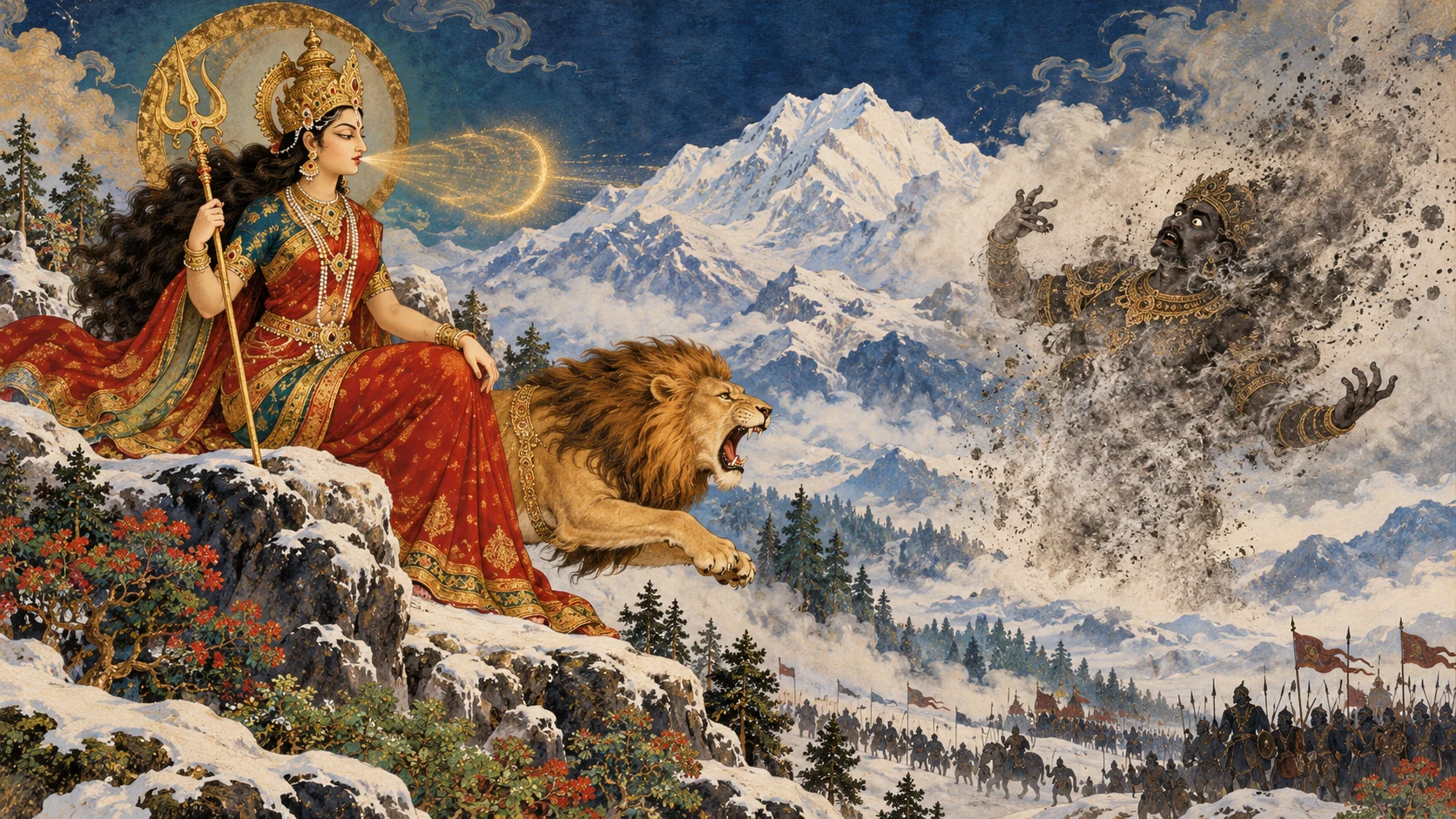
Adhyaya 6 picks up at once. The messenger, full of anger, returns and tells the asura king everything in detail. Shumbha is furious. He calls Dhumralochana, a chief of his army, and orders him to bring the Devi by force, dragging her by the hair if need be, and to kill anyone who tries to protect her, whether a deva, a yaksha or a gandharva.
Dhumralochana sets out with sixty thousand asuras, finds the Devi on the snowy mountain and shouts at her to come to his master, or be taken by force. She replies: "You have been sent by the lord of the asuras. You are strong, and you have an army. If you take me by force, what can I do to you?" He rushes at her, and with nothing more than a sound, a single "hum", she turns him to ash. His army then attacks the Devi with arrows and other weapons. Her lion falls on it, and the force is destroyed. Hearing this, Shumbha sends Chanda and Munda.
What follows, in brief: in Adhyaya 7, Kali springs from Ambika's brow, destroys Chanda and Munda and receives the name Chamunda. In Adhyaya 8, the asura Raktabija, from every drop of whose blood a new asura springs, is defeated, with the powers of the devas themselves joining the Devi's side. In Adhyaya 9, Nishumbha falls. In Adhyaya 10, Shumbha taunts the Devi for relying on the strength of others, and she answers with a line that sounds like a commentary on our hymn: "I am alone here in the world. Who else is there besides me?" All the other goddesses then merge back into her body, and she faces Shumbha alone, and defeats him. Adhyaya 11 is the devas' great hymn of thanks, Adhyaya 12 gathers the Devi's promises to those who hear her story, and Adhyaya 13 returns to the forest, to Suratha and Samadhi, and to their boons.
One Devi, many forms
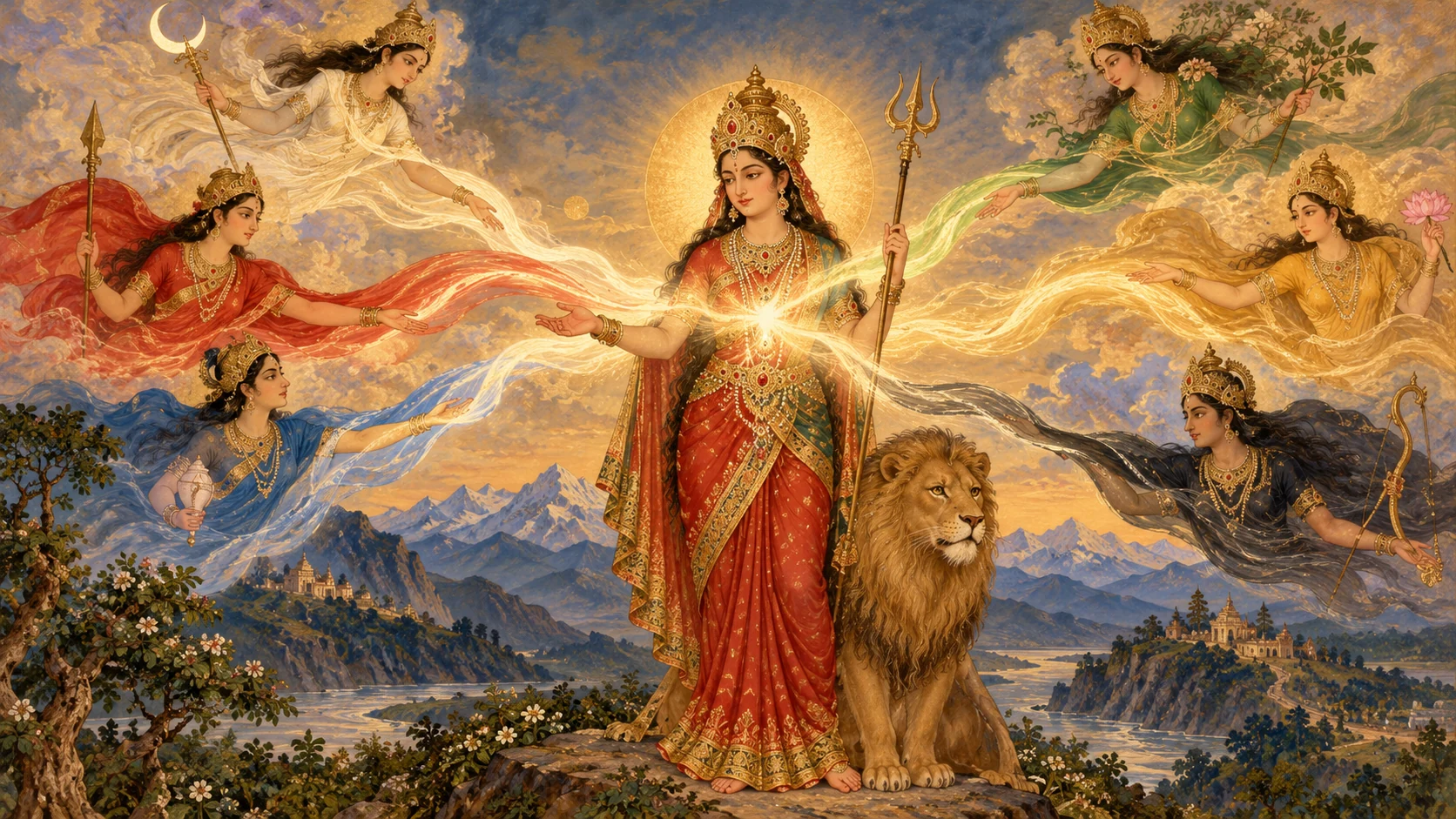
Step back and look at Adhyaya 5 as a whole, and a pattern appears. This is our reading, not a claim the text makes in so many words.
In this single adhyaya, the Devi is praised as Vishnumaya, appears as Shivā, is named Ambika and Kaushiki, is called Durga, while Parvati becomes Kalika. The hymn says the Devi lives in all beings in twenty-one forms; the story that follows shows her literally taking more than one form, and coming out of a body that did not seem to be her. A few adhyayas later she will say it outright: "I am alone here in the world." The hymn and the story are saying the same thing in two different languages, one of praise and one of narrative.
There is also a contrast between two ways of seeing. The devas, defeated and humbled, see the Devi in everything, even in hunger and sleep. The asuras, at the height of their power, see her as one more object to own. The text does not draw this moral for us, but it is hard to miss: the people who have lost everything are the ones who see clearly, while the people who have taken everything cannot see what is in front of them. In that light, Suratha and Samadhi, who are listening, are being told something about themselves.
And finally there is the line itself. Read in its place, it is not a statement made in comfortable times. It is sung by beings who have lost their homes and their work, holding on to a promise on a mountain. That may be part of why it has travelled so far.
The line in our time
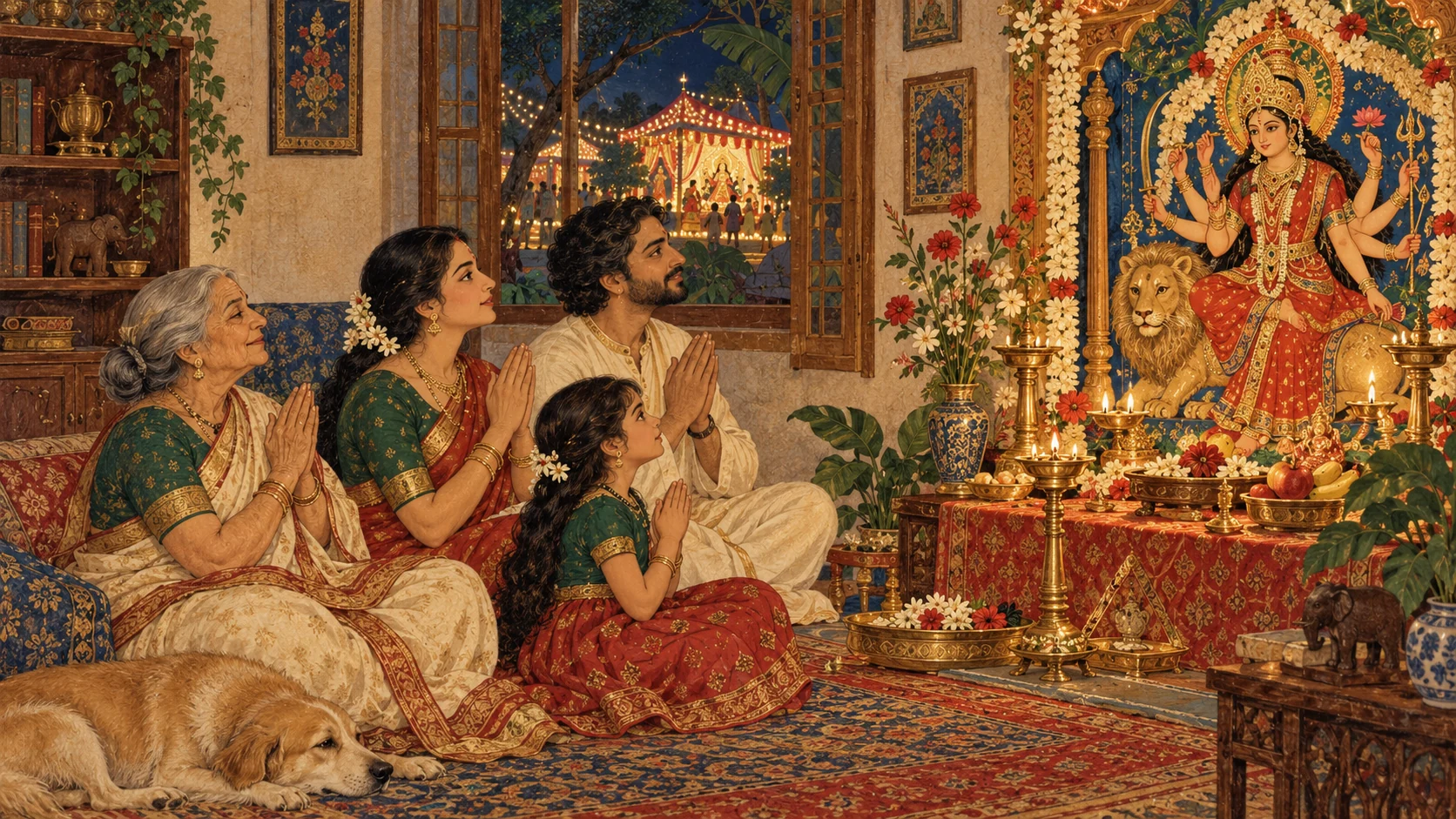
Today the hymn lives well beyond the pages of the Markandeya Purana.
During Navaratri, the Durga Saptashati is recited in temples and homes across India and wherever Hindu families live, sometimes over the nine days, sometimes in a single sitting. The Devi herself, in Adhyaya 12, speaks of those who listen to her story with a focused mind on the eighth, ninth and fourteenth days of the lunar fortnight, which helps explain the special place of Ashtami and Navami in this season. In many recitation traditions, the passage of praise from Adhyaya 5, beginning with "namo devyai mahadevyai" and running through the "ya devi" lines, is also recited on its own, where it is often called the Tantrokta Devi Suktam. (At the very end of the text, the merchant Samadhi is said to have done his tapas while reciting a "supreme Devi Sukta"; the text does not say which hymn that was, though some readers connect it with this one.)
In Durga Puja pandals, especially in Bengal and among Bengali communities everywhere, the Chandi is recited during the days of the Puja, and the "ya devi" lines are among the most recognisable sounds of the season. For many families in Bengal, the season begins before dawn on Mahalaya with a much-loved radio programme of Chandi verses and songs, in which these lines are a high point.
In homes, the line is part of evening prayers, often learned by ear long before it is understood, and it travels in festival greetings on Ashtami morning.
And in music, it has been set to countless tunes, from temple chants and classical renditions to devotional albums and modern recordings. The line seems made for singing: a long first half that names the form, and a short, repeated second half that simply bows.
Some people recite all twenty-one forms; some sing only the shakti line; some say it once with folded hands. Knowing where it comes from need not change how anyone uses it. But it can add something: devas on a mountain, a promise remembered, a Devi stepping out of Parvati's body, and a calm, smiling reply to a messenger who thought she could be owned.
A note on reading
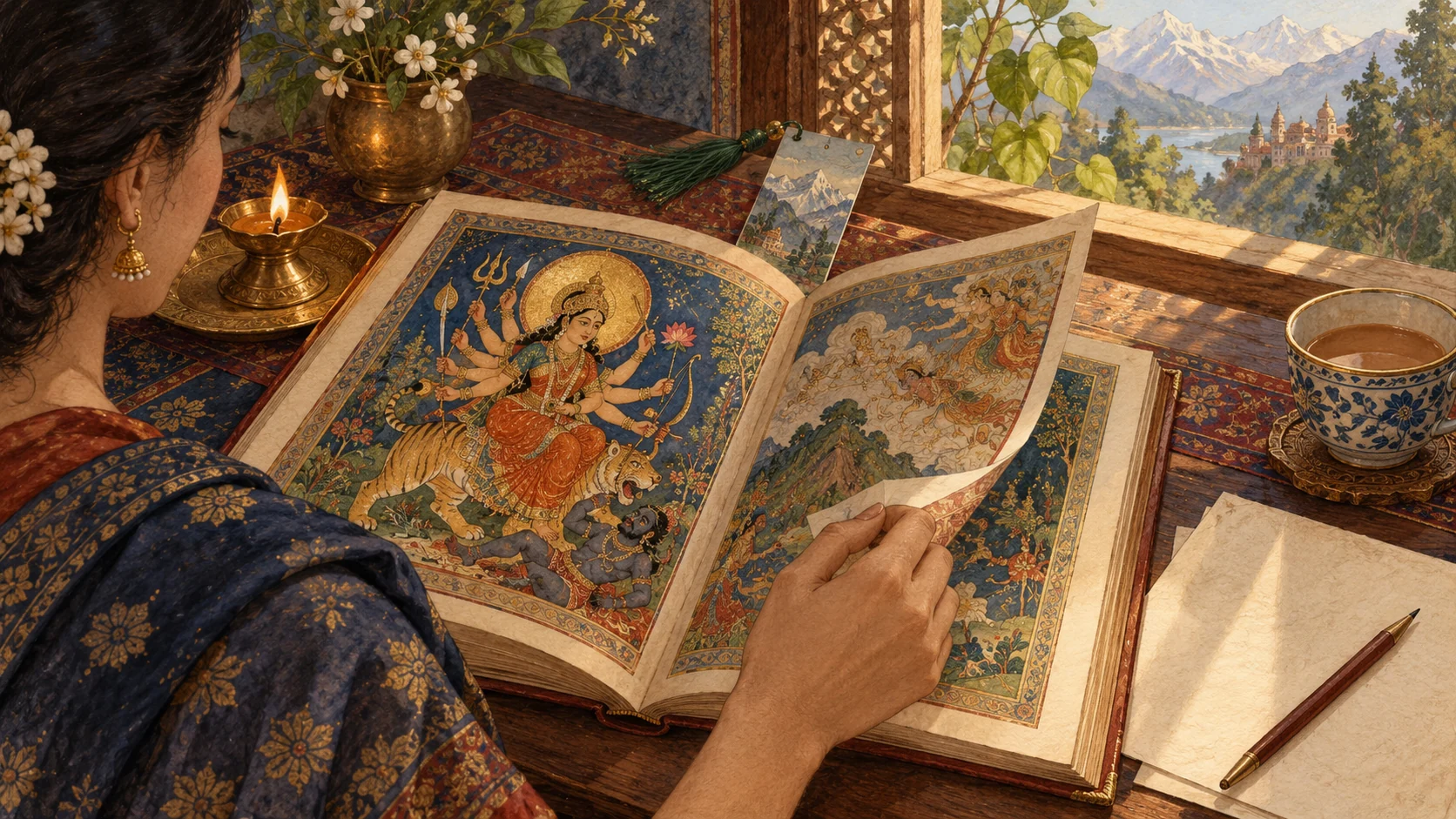
This essay follows the Sanskrit text of the Durga Saptashati (Devi Mahatmya), Adhyayas 1, 4, 5, 6 and 13, with brief references to Adhyayas 7 to 12, from the Markandeya Purana. The English and Hindi renderings here are prepared for FreeHindu and kept simple; longer speeches are narrative paraphrases rather than word-for-word translations. Where we have offered a reflection or a reading of tone, we have said so; the text is always the first word, never ours.
To go further, read Adhyaya 5 in full, slowly, with a word-by-word guide, then Adhyayas 1 and 13 to see how the frame story opens and closes. Notice how often remembering returns.
Which of the twenty-one forms speaks to you, and why? Did you grow up hearing this line in a particular voice or tune? We would love to hear.
Ask us: free@freehindu.in
Read closely. Think freely.
Sources and verse guide
- Sanskrit Documents: complete Devi Mahatmya. Frame story: Chapters 1 and 13; remembered promise: 4.32–42 and 5.5–7; the hymn: 5.9–82; Kaushiki and Kalika: 5.84–88; the vow and messenger: 5.118–129; Dhumralochana: 6.7–20; Kali’s emergence: 7.5–6; the Devi’s declaration of unity: 10.5–6. Numbering follows this edition.
- AuroBharati, Sri Aurobindo Society: Chapter 5. A parallel Sanskrit text with transliteration and an English translation for comparison; its translation is not reproduced here.
- Indrani Chatterjee, “Goddess Encounters”. Scholarly context for the sixth-century dating of the Devi Mahatmya.